Gelephu International Airport Project
Gelephu International Airport has been awarded the WAF Future Project of the Year 2025 in the infrastructure category, standing out among more than 460 global entries as a strategic airport located on the Bhutan–India border.

The project is designed by BIG Group. Gelephu International Airport, within the infrastructure category, forms a critical component of the Gelephu Mindfulness City (GMC) masterplan led by BIG (Bjarke Ingels Group).

The project’s complex engineering and aviation planning were developed in close collaboration with aviation engineering expert NACO, alongside leading consultancy firms Arup and Cistri. Locally sourced timber has been used in the construction.
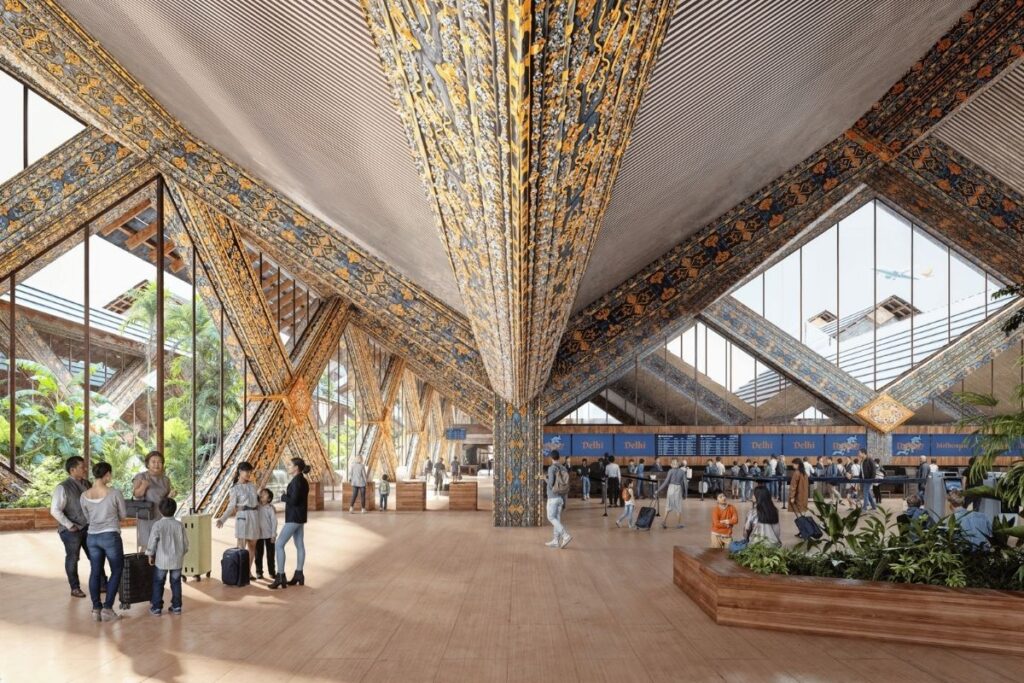
Throughout the terminal, from the exterior envelope to interior common areas, regional Bhutanese craftsmanship is integrated through intricate elements such as Shing-Zo (carpentry), Par-Zo (carving), Lha-Zo (painting), and Tshar-Zo (weaving).

The façade design draws inspiration from the Kachen, a sacred wooden pillar. The building meets its energy demand through photovoltaic panels integrated into the roof structure, aligning with Bhutan’s national objective of maintaining a carbon-negative status.

The long-term operational capacity is substantial, with the airport initially planned to handle 123 flights per day, while annual passenger numbers are projected to reach 5.5 million by 2065. Prioritising passenger wellbeing, the design incorporates unique indoor and outdoor spaces where travellers can engage in activities such as yoga, gong baths, and meditation.
WAF 2025 Future Project of the Year Gelephu International Airport
Project Details
Project Type: Second International Airport and Transport Hub
Location: Gelephu, Sarpang District, Kingdom of Bhutan (a strategic location near the Bhutan–India border and the Paitha River)
Scope: Central component of the Gelephu Mindfulness City (GMC) masterplan
Area: 68,000 m² (terminal building). Total site area exceeds 500 acres (200 hectares)
Client: Royal Government of Bhutan
Architect: BIG (Bjarke Ingels Group)
Masterplan: BIG, Arup and Cistri
Aviation Engineering: NACO (Netherlands Airport Consultants)
Lead Design Consultant and Engineer: Aurecon
BIG Project Leads: Bjarke Ingels, Frederik Lyng, Giulia Frittoli, Per Bo Madsen (Project Manager), Sorcha Burke (Design Lead)
Other Collaborators: Magnolia Quality Development Corporation Limited (MQDC), Changi Airport Planners and Engineers, Influit, WT Partnership
Operator: Department of Civil Aviation
Design Start: 2023 (commission), 2025 (design phase)
Planned Opening Date: 2029
Runway: Existing runway 1,500 m (with planned extensions)
Capacity (Initial): 123 flights per day
Estimated Passenger Capacity: 1.3 million passengers annually (by 2040) / 5.5 million passengers annually (by 2065)
Photo Credits: